
News
Remembering Reynolds Farley: An Expert on Detroit, the Census, and America’s Racial Divide
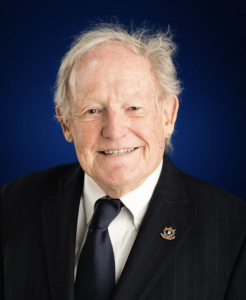
ANN ARBOR, Mich. — Reynolds (Ren) Farley, a sociologist and demographer who used Census data to illuminate the persistence of racial segregation in American cities, died on September 12, at 88. He was the Otis Dudley Duncan Professor Emeritus of Sociology and Research Professor Emeritus at the Population Studies Center at the University of Michigan, where he taught and conducted research for nearly four decades.
Institute for Social Research Director Kate Cagney called him “a recognized leader among social demographers and an authoritative analyst of racial and ethnic relations.”
“Ren Farley dedicated his scholarship to addressing one of our nation’s most vexing social challenges — racial inequality and residential segregation,” said Maria Krysan, a sociologist at the University of Illinois Chicago and a close collaborator. “In this endeavor, he stood as an exemplar of energy, inspiration, commitment, and integrity for all of us — his readers, students, collaborators and colleagues.”
Farley built his career around dogged curiosities fed by data produced by the U.S. Census Bureau from 1960 to 2020. His monographs, including The Growth of the Black Population (1970), The New American Reality (1996) and Detroit Divided (2000) became standard reference points for anyone studying race, residence, and opportunity in America.
Remembered equally for his personal, parallel passions, “Ren managed to be, at once, an intellectual giant, a dynamo at and outside of work, and also a totally approachable person who was always deeply curious about the people in his orbit,” said Sarah Burgard, Director of the Population Studies Center.
From Akron to the University of Chicago
Farley was born in 1938 in Harrisburg, Pa., and moved as a toddler to Akron, Ohio, where his father had taken a wartime job with B.F. Goodrich. He later traced his interest in demography to childhood habits — an attraction to statistical compilations of city and state population trends, and to American history generally.
His interest crystallized at the University of Notre Dame, where a course taught by social demographer Donald Barrett introduced him to population studies. Barrett encouraged Farley to attend the 1958 PAA meetings in Chicago — his first exposure to the field’s professional community. Farley would serve as PAA president 30 years later.
After earning his B.A. in 1960, Farley enrolled at the University of Chicago, serving what he called an “apprenticeship” under Otis Dudley Duncan and Beverly Duncan. Farley’s lifelong project investigating racial residential segregation began with his analyses of Chicago’s population just as 1960 Census data were becoming available. His dissertation examined the historical puzzle of why Black fertility, once lower than white fertility, had become dramatically higher by the 1960s.
Four Decades at Michigan
Farley taught briefly at Duke University before joining Michigan’s sociology department in 1967 — the same year Detroit erupted in civil unrest, an event that shaped his research agenda for the rest of his career. He rose to professor in 1976 and research professor in 1979, and in 1996 was named, in honor of his mentor, the Otis Dudley Duncan Collegiate Professor of Sociology.
He served two terms as department chair and three as acting chair, plus a decade as associate director of the Population Studies Center. When the university presented him its Distinguished Faculty Achievement Award in 1995, the citation placed him in “the top echelon of social demographers” and praised research that “enlightened the national discourse on social policies concerning families, welfare, health and education.”
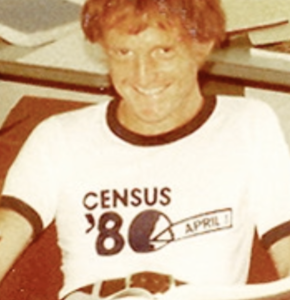
Farley undertook ambitious projects to marshal decennial census data into sweeping national portraits, often with the Russell Sage Foundation. Bill Frey, a longtime Michigan colleague, called these “herculean efforts,” as they required Farley to coordinate analyses among scholars nationwide alongside a national advisory committee of Census experts.
Works including State of the Union: America in the 1990s (1995) and The New American Reality (1996) — winner of the ASA’s Otis Dudley Duncan Publication Award — and The American People: Census 2000 (2005, with John Haaga) “helped to establish Ren as a national authority on American social and demographic trends and as an authority on using U.S. Census data for these purposes,” Frey said.
“Ren Farley was a prolific scholar renowned for his pioneering research on the causes and consequences of persistent residential segregation, an expert on the history of Detroit and an optimist about its ability to revive,” said Sheldon Danziger, President Emeritus of the Russell Sage Foundation.
Farley’s service and reach into public life included his Congressional testimony on school segregation, Census questions on race and ethnicity, and nonmarital birth trends; membership on the Census Bureau’s Advisory Committee on Population Statistics, which he chaired in 1980–81; and service as a senior research consultant to the National Academy of Sciences’ Committee on the Status of Black Americans. He served as PAA president in 1988 and was elected a fellow of the American Academy of Arts and Sciences in 1992.
Detroit Scholar
The city of Detroit served as Farley’s great case study. His work with the Detroit Area Study, and later Detroit Divided (2000, with Sheldon Danziger and Harry Holzer), traced how the city’s racial geography had been shaped by discrimination, disinvestment, and the suburbanization of its Black middle class.
Asked in 2018 what drew him to Detroit so persistently, Farley traced it to the questions that had animated his dissertation. “My interest in the city comes from my work in sociology,” he said. “Generally when immigrants came to the United States, they’ve been assimilated after some very rough period… African Americans are still highly segregated, although the suburbs of Detroit are now becoming quite integrated so there is progress. But there is something very different about the experience of African Americans in the city.”
Jeffrey Morenoff, whose impactful research with Farley included analysis of the 2020 Detroit Census undercount, said his mentorship by Farley changed his path as a scholar. “He was a truly remarkable mentor and collaborator whose profound knowledge of Detroit — including its deep history of segregation and inequality but also its recent economic resurgence — profoundly shaped my path as a researcher,” Morenoff said. “Beyond his landmark work on Detroit, Ren’s unparalleled expertise and enthusiasm for the U.S. Census Bureau inspired me to focus on the vital mechanics of population estimation and the critical fight against urban undercounting.”
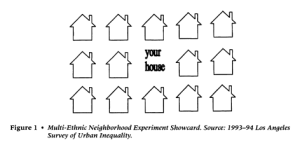
Farley advanced demography and our understanding of Detroit with survey methods that were both effective and approachable, said Burgard. With Howard Schuman, he developed the “Farley-Schuman showcard method” for the 1976 Detroit Area Study, using simple illustrations that looked similar to a cluster of Monopoly game houses to help survey respondents envision the racial composition of hypothetical neighborhoods. He used the approach for decades, but later moved with the times and worked with colleagues to create video vignettes of real neighborhoods that respondents viewed to be cued to aspects of residential segregation, safety, and amenities.
“These methods really allowed people in surveys to express themselves in ways that made sense to them, that captured the empirical realities the Ren studied, and that met important scientific criteria,” said Burgard. “He worked as a partner with the community to understand their views and provide critical information for scholars and policy markers. That’s the kind of scholar Ren was– curious, collaborative, and the furthest thing from patronizing. That’s part of why his data and findings endure, and why it’s so tough to get all of his wonderful personal qualities into one anecdote.”
Detroit Tour Guide
Farley’s rigor and warmth ran through his long-running course on Detroit’s history and future at the Gerald R. Ford School of Public Policy, capped each term by a daylong bus tour he narrated himself, from the Ford Rouge plant downtown, up Woodward, and through neighborhoods from Boston-Edison to Brightmoor.
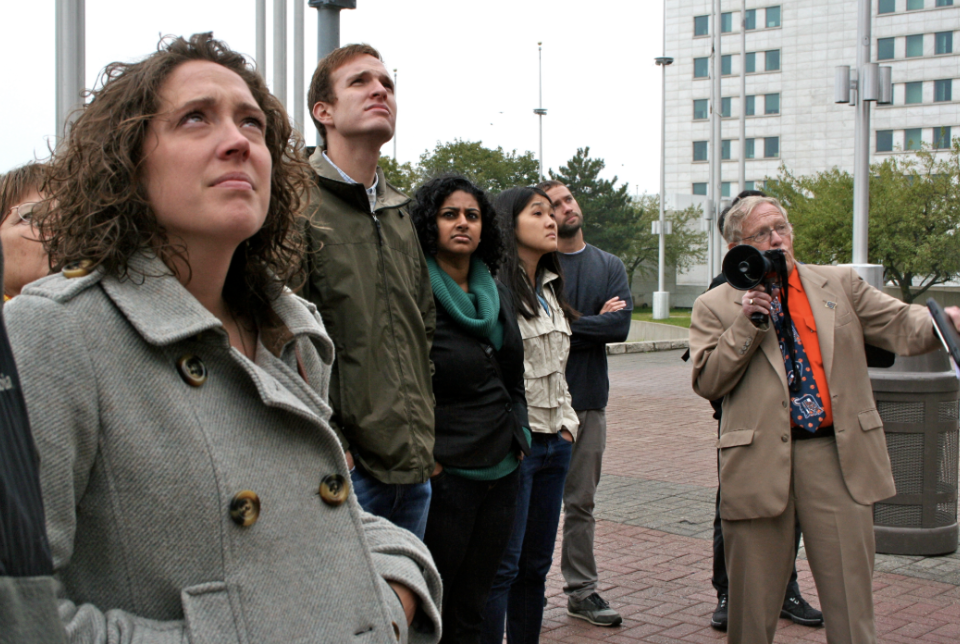
A reporter from the School of Information described the experience of riding along one of Farley’s city tours in 2006: “As the bus meandered the streets Farley explained how different ethnic groups settled in various neighborhoods and what impact they had on the city. In his role at the U-M Population Studies Center, he carefully tracked Detroit census data and watched the ebb and flow. The life of some neighborhoods seemingly disappeared entirely, while that of others has thrived. Those who live outside the city don’t often picture the latter.”
Farley was glad to take any group on his Detroit tour, including the Detroit chapter of the Society of American Baseball Research (SABR). Farley led a bus tour for ISR in 2018, departing from the Institute, as a fundraiser for the Laurie Staples Staff Development Fund, supporting the training of ISR staff pursuing undergraduate or masters degrees.
Decades beyond his formal retirement in 2004, Farley tracked the pulse of the city and its changes. He wrote extensively for Bridge magazine and was frequently called upon by the press to answer questions about Detroit neighborhoods and development. Farley also maintained a website on Detroit’s history and future, www.Detroit1701.org.
“Many times, when he and I went to Comerica Park he would stop to take pictures of something to add to his Detroit website,” said his friend and collaborator Lisa Neidert. “I have forgotten what he took pictures of but remember his infectious enthusiasm.”
Farley rarely missed an opening game for the Tigers and appeared frequently on the Jumbotron at Comerica because his straw boater hat, worn in the style of the 1910s, drew notice.
Beyond Demography
Farley continued his Detroit course and research collaborations and scholarship for years after retirement, teaching well into his 80s and presenting on the 2020 Census and population stagnation at PAA meetings in recent years.
Despite his enduring career accomplishments, Farley told his wife of 61 years, Gail, that his proudest moments were in other areas. A train enthusiast who documented old train stations in Michigan, Farley was thrilled to have been among the last passengers to board the historic Akron, Canton, and Youngstown Railroad train across northern Ohio, and to have seen Don Larsen pitch a perfect game for the Yankees in the 1956 World Series.
The energy and enduring curiosity that seeded his accomplishments also gave Farley a remarkable spark that friends described as mischievous, quirky, and infectious.
“He possessed a rare, memorable blend of absolute formalism — often charmingly evident in his emails drafted as memos — and an enduring, old-timey warmth and folksy good humor that made everyone around him feel valued,” said Morenoff.
Farley was a prolific writer of thank you notes.
“Mostly, what I remember about Ren is his exuberance and wide variety of pastimes,” said Neidert. “If he was interested in something, he put time and energy into it and became an expert whether it was trains, baseball, the census, demography, urban history or architecture.”
Burgard also remembered Farley’s “balance in life” that paired academic achievement with marathoning, “some very fun automobiles,” and training service dogs. “I have rarely seen such joy in the Institute for Social Research as when he’d bring in a golden retriever puppy for socialization training.”
Farley raised eight service dogs for Canine Companions, the national organization based in Santa Rosa, Calif., and competed in 31 marathons, running his best in three hours and six minutes.
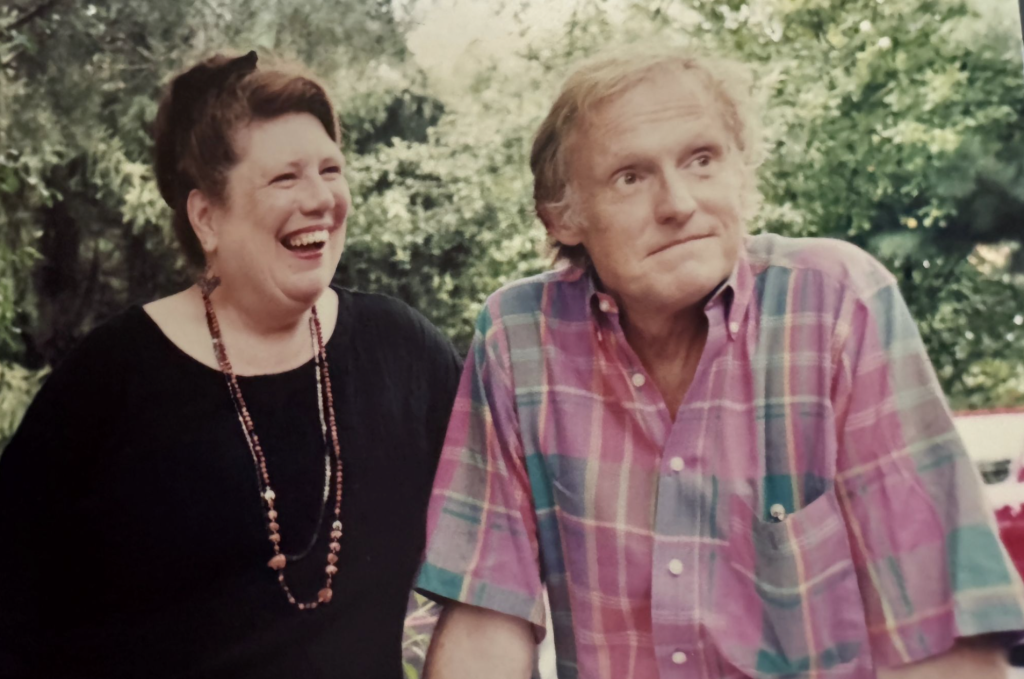
With his wife, Gail, Farley loved to travel to the island of Réunion, east of Madagascar, and to throw parties, particularly an annual Goat Roast.
“All of us who were blessed to know him will forever hold on to his incredible joie de vivre,” said Krysan. “We’ll always remember his infectious love of the Tigers, a glass of wine with lunch, Amtrak, dogs, running in all kinds of weather, Detroit—and, of course, Demography.”
He is survived by his wife, Gail Farley. A celebration of life will be held at a date to be announced. Ren Farley will be remembered during the Memorial Service at PAA’s annual meeting in Seattle this March. Cards may be sent to Gail Farley at 807 Asa Gray Dr #306, Ann Arbor, MI 48105.
This post was written by Tevah Platt, communications manager for the Population Studies Center. The Comerica Park photo is by Robin Buckson.