
News
Chitwan Valley Family Study 30th Anniversary
The Chitwan Valley Family Study (or CVFS) was launched in 1995 and celebrated its 30th anniversary this year with a series of events in Nepal. The CVFS was originally designed by William Axinn, building on deep roots in both Survey Research Center (SRC) and Population Studies Center (PSC). Axinn was trained in the Family and Demography Program in the late 1980s, which was led by Arland Thornton and Tom Fricke and bridged SRC and PSC. His training included extensive work on both Fricke’s Tamang Family Research Project (in Nepal) and Thornton’s Intergenerational Panel Study (in the U.S.; itself an outgrowth of work launched by Ronald Freedman and continued by Thornton and Deborah Freedman). The CVFS design also built directly on important lessons learned from PSID about the design and implementation of whole family panel studies. The original NICHD R01 to launch the CVFS was funded in 1994, with Axinn as PI and Thornton, Fricke, and SRC’s Dan Hill all as co-investigators. Axinn returned to SRC and PSC in 1998 and across the years since then dozens of other SRC/PSC scientists, post-docs, and students have been engaged in CVFS (see a list of participating scientists).
CVFS co-director Dirgha Ghimire, was originally trained in survey interviewing, including the recruitment, training, certification, and supervision of interviewers, at SRC. He then applied those lessons to recruit, train, and supervise the interviewers in Nepal for the launch of the CVFS in 1995. Once baseline data collection was complete, Ghimire came to the U.S., completing his PhD in sociology and demography at Michigan. Ghimire established the Institute for Social and Environmental Research – Nepal (ISER-N) as the long-term institutional home for the CVFS and for ongoing investments of support from PSC and SRC. The creation of ISER-N helped to institutionalize the relationship between ISR centers and ongoing research in Nepal, with dozens of different ISR staff engaging in the work of ISER-N across the decades. For example, this includes the evolution of ISER-N infrastructure from face-to-face interviews, to telephone interviews, to web-based interviews, to current state-of-the-art mixed mode data collections using robust computer-assisted interviewing tools. The partnership also includes the evolution of biospecimen collection from samples of local flora and photo-trapping of jungle animals, to saliva-based DNA, hair cortisol, and most recently whole blood.
Over one week in November, members of both ISR and ISER-N celebrated the CVFS 30th anniversary with three large events in Nepal. ISR was represented by Axinn and Ghimire as well as Stephanie Chardoul (Survey Research Operations) and Emily Treleaven (Society, Population, and Environment program). SRO works closely with ISER-N to provide technical system, interviewer training, and data collection support; Emily is PI of projects utilizing the CVFS sample, and coordinates ISER-N activities with Axinn and Ghimire. The broader U-M community was represented by the Center for Global Health Equity’s founding director Joe Kolars. The international survey data collection community was represented by Harry Wijnhoven, who is on the Board of Directors of Statistics Netherlands and the CEO of Blaise. The first event was in Kathmandu, bringing national policy makers, scientists, and representatives of donor organizations together to summarize the 30 years of scientific advances and to discuss the potential policy implications of those advances.
The second was an event in Chitwan focusing on similar topics with local government representatives and leaders of local science and program implementation organizations.
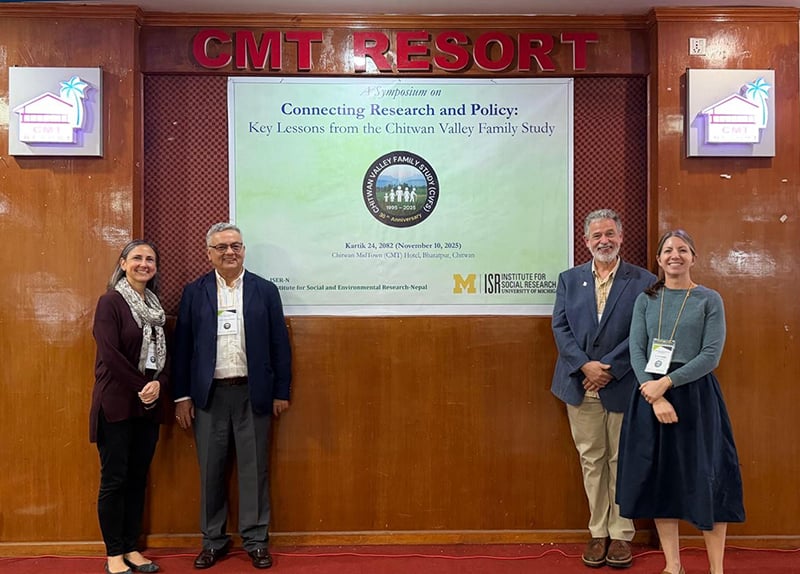
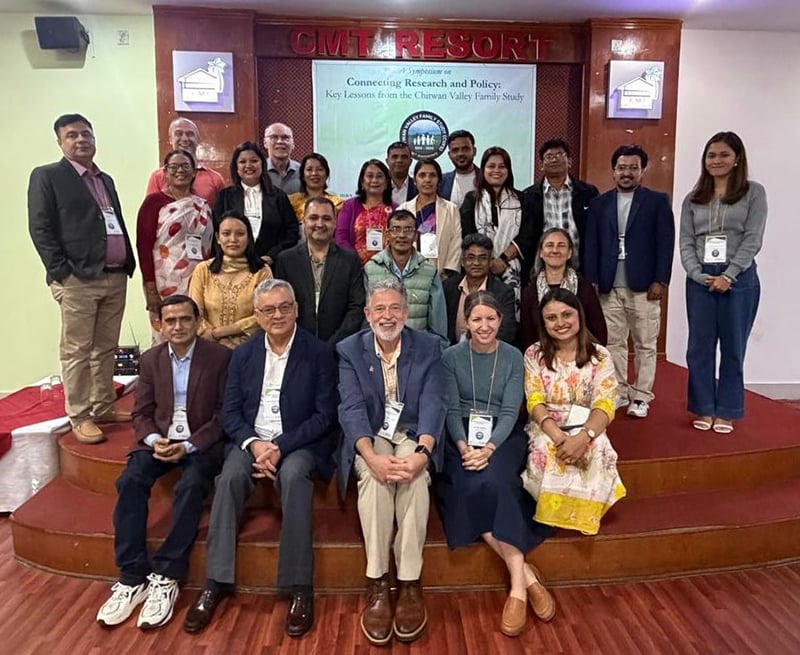
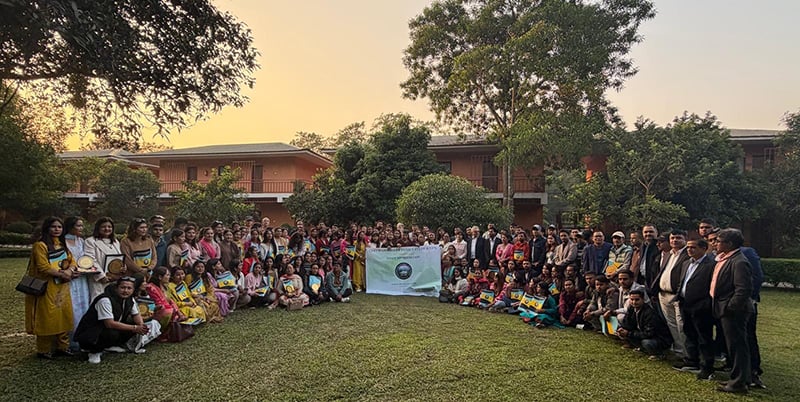
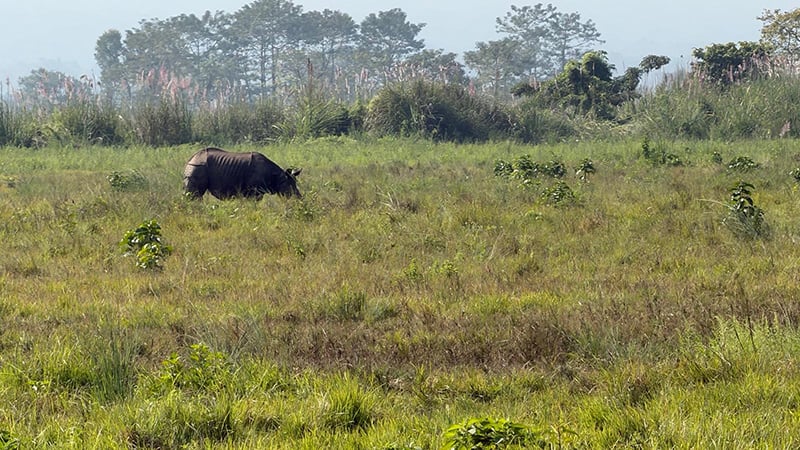
The third was a joyful celebration with the full 165 current staff of the ISER-N. In addition to highlighting the impact of CVFS, staff were recognized for their years of service (some have contributed to CVFS for the entire 30 years!). This last event ended with a jeep safari through Chitwan’s jungle reserve – the most tangible demonstration of the true roots of Chitwan Valley.
All involved in Nepal expressed gratitude to both SRC and PSC for their long-term support for building this study and maintaining this important research infrastructure.